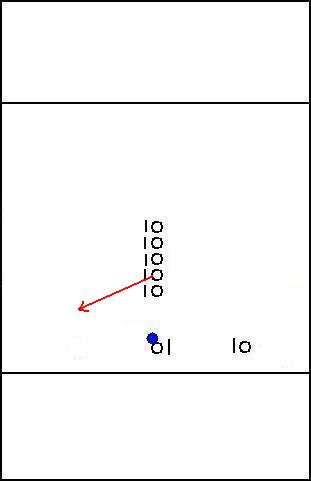
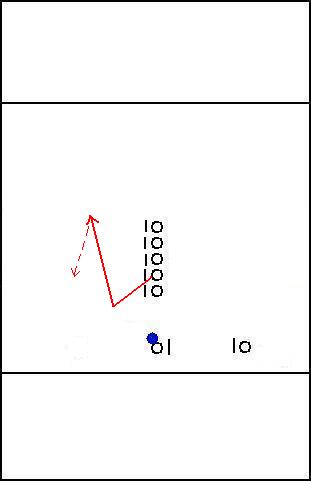
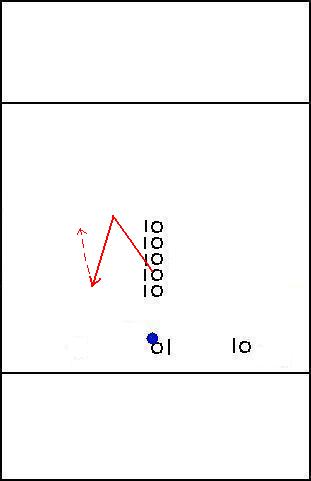
So so cutting - Often people cut like this: without making a fake they just run to the open side. The problem with this type of cut is that it's very easy for the defender to stay close to you. (You will still get open against a weak defender though).Good cutting: in-out - A much better cut is one where you run one way and then suddenly change direction, like this in-out cut. This is much harder to defend. If you haven't received the disc after going deep, and there is still time and room, you can even cut back again towards the disc (dotted arrow). If you don't receive the disc, run back to the stack and wait for another chance.Good cutting: out-in - Same as the previous cut but first running deep and then towards the disc.
Some general remarks about cutting:
Really run a few steps before suddenly changing direction. This way you're sure your defender has committed in chasing you and he will be off balance the moment you change direction.
In case your defender is not chasing you during the first part of your cut, keep on running in the same direction and yell that you're open.
Do not cut within five meters of the handlers. This is their space and they need it for the dump and the swing when the stall count gets high (see next pictures).
Offence - Handling
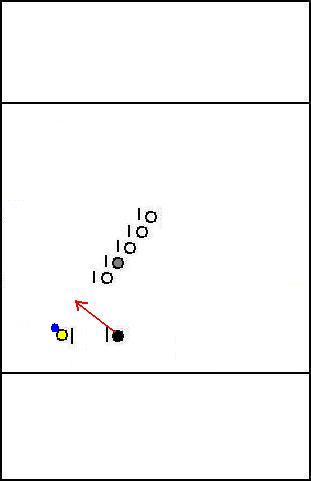
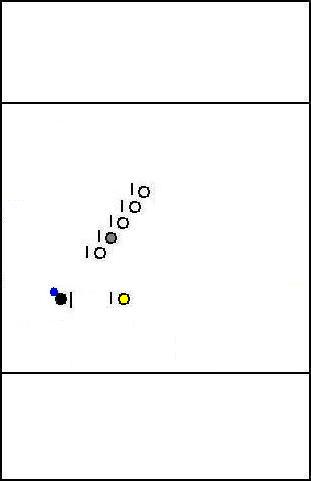
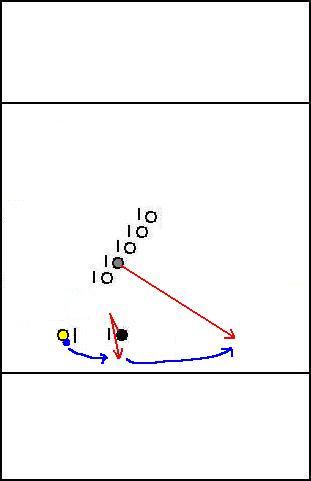
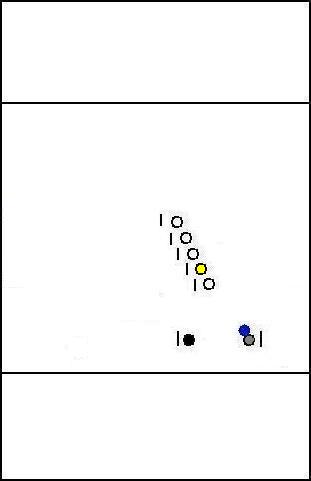
Forward dump cut - Imagine the disc is on the sideline and the stall count is at four or five. In that case, the handler with the disc (yellow) should stop looking to the stack and play to his dump (black). (There is a third handler - gray - somewhere in the stack). The dump has two cutting options. In this picture he cuts forward.Resulting position - If the dump cuts forward, this is the resulting position: we've gained a few meters forward, the black handler has the disc and the yellow handler has become the dump. The stack has repositioned itself somewhat deeper and starts cutting again.Backward dump cut & swing - Although the foward dump cut is the preferred one because we gain some meters forward, good defenders will often stop this. The alternative for the dump is to cut backwards. After a backwards cut, it's very advantegeous to swing the disc to the third handler (gray) who runs from the stack. Throwing sideways like this has the advantage that it completely opens up the field and often makes possible a foward flow on the closed side. This important play is called dump-swing.Resulting position - If no quick forward passes were possible after the swing, this would be the resulting position: we've moved the disc to the other side of the field. The gray handler has the disc, the black handler has become the dump and the yellow handler has gone to the stack. The stack has repositioned itself and starts cutting again.
Some general remarks on handling:
After stall count four or five, the handler with the disc turns his body completely towards the dump and commits to the dump (no more throws to the stack). And don't panic. If you give the dump enough time he will almost always be able to get open.
The dump only starts cutting after the handler with the disc made eye-contact with him.
If the handler with the disc really cannot reach the dump, the third handler has to help out.